

Greetings, reader,
Dr. Rukundo here! I am the NIR Applications Specialist at BUCHI Corporation. It is easy to assume humans raise plants, but have you ever thought that maybe plants are actually raising us? I know I have. Consider this: we need plants to survive, but plants do not necessarily need us. They were here long before we were. And even for meat lovers, animals depend on plants for nutrition. But I guess that is enough philosophy for now!
Plants play a vital role in sustaining life on Earth – they nourish us, provide oxygen, and serve as the foundation of the global food chain. This makes their growth and health critical to our survival, which is where fertilizers come into play. You may be wondering, what is the connection between fertilizers and NIR spectroscopy? That is a great question, and I encourage you to keep reading to find out.
Fertilizers are indispensable to modern agriculture, playing a crucial role in enhancing crop yields, ensuring food security, and supporting the global food supply chain. As the world’s population grows, the demand for agricultural productivity continues to rise, placing fertilizers at the center of food production systems. With such importance, the accurate analysis of fertilizers is essential to ensure both efficiency and sustainability in agricultural practices.
In addition to carbon, hydrogen, and oxygen, which they get from the atmosphere and water, plants need numerous essential nutrients for their growth and health. Fertilizers are added to soil to provide these. They typically contain macronutrients (Nitrogen, Phosphorus, and Potassium – NPK), secondary nutrients (such as, Calcium, Magnesium, and Sulfur) and other micronutrients (such as Iron, Manganese, Zinc, Copper, Boron, and Molybdenum). Fertilizers play a pivotal role in replenishing these nutrients and ensuring optimal plant development, which directly impacts food production.

Without fertilizers, global agricultural productivity would decline drastically. According to the International Fertilizer Association (IFA), fertilizer usage accounts for approximately 50% of global crop yields, helping to feed an ever-increasing global population. Fertilizers help farmers maximize crop production on limited arable land, ensuring that the food value chain from farm to table remains strong and efficient. As such, accurate fertilizer analysis is key for the following reasons:
- Ensuring Correct Nutrient Levels: Fertilizers must contain the right balance of nutrients to meet crop needs. Too much of certain nutrients can lead to environmental pollution, while insufficient nutrients may result in poor crop yields.
- Regulatory Compliance: Fertilizer products must meet stringent regulatory standards. Fertilizer analysis ensures that these products comply with government regulations and quality standards.
- Quality Control: The quality of fertilizers impacts both agricultural outcomes and environmental health. Subpar fertilizers can harm soils, reduce crop yields, and contribute to pollution.
Traditional fertilizer analysis methods, such as wet chemistry, involve complex processes like digestion, filtration, and chemical reactions that are both time-consuming and resource intensive. Additionally, these methods often require the use of hazardous chemicals and specialized equipment. In contrast, NIR spectroscopy is a non-invasive technique that uses light to measure the chemical composition of materials. It is a fast, efficient way to analyze fertilizers, offering several advantages over traditional methods, such as reduced time and cost.
- Speed: NIR analysis can provide results in a matter of seconds, compared to hours or even days with traditional methods.
- Non-destructive: NIR is a non-invasive technique, meaning samples do not need to be destroyed during analysis. This saves both time and resources.
- Cost-effective: NIR analysis eliminates the need for costly reagents and chemicals associated with traditional laboratory testing.
- Real-time results: With the ability to analyze in near real-time or even in real-time, NIR provides immediate feedback during the production process, allowing for quick adjustments and minimizing waste.
- Precision and accuracy: NIR spectrometers, like those provided by BUCHI, are calibrated to offer highly accurate and reproducible results, ensuring consistency in quality control.
At BUCHI, we provide innovative NIR solutions that help fertilizer manufacturers and quality control labs achieve accurate, fast, and efficient analysis. Our NIR instruments are designed for ease of use and integration into production environments, providing real-time or near real-time monitoring of key fertilizer parameters.
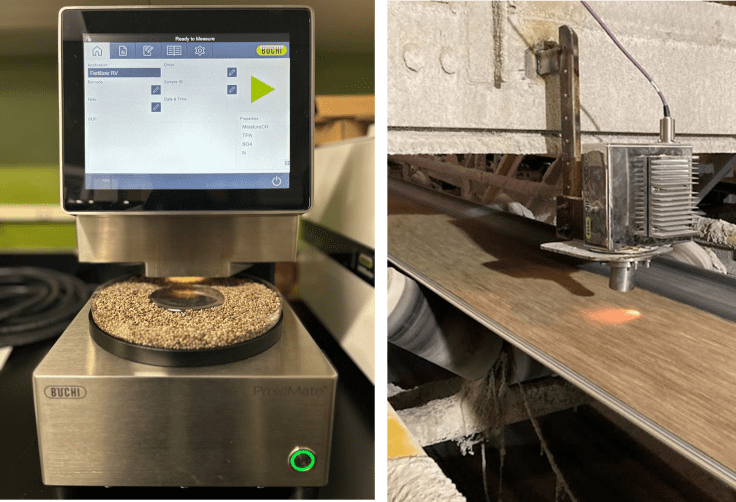
The BUCHI ProxiMate benchtop unit (left) enables rapid lab and at-line measurements, while the NIR-Online system (right) provides real-time, continuous process monitoring for optimized quality control and efficiency.
For example, one of our clients, a leading fertilizer manufacturer, was able to significantly improve their production efficiency by integrating BUCHI’s NIR-Online system for real-time monitoring. This helped them fine-tune their formulations and maintain consistent quality.

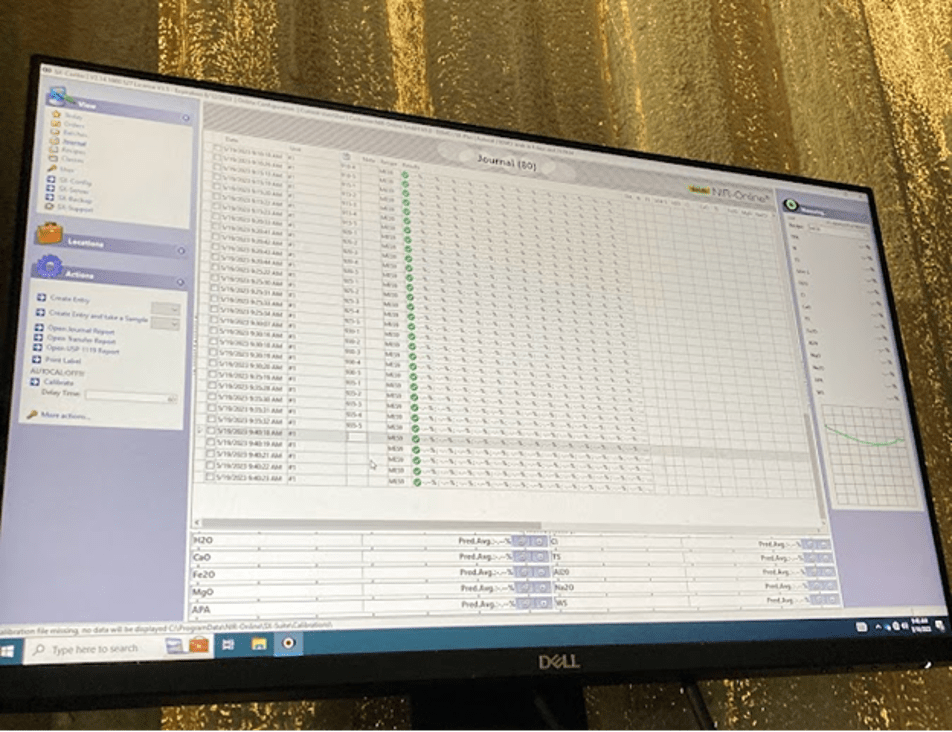
Furthermore, BUCHI’s advanced software offers powerful data interpretation and trend analysis tools. This enables fertilizer producers to track production performance over time, identify potential quality issues early, and adjust processes accordingly. BUCHI’s NIR solutions ensure reliable and reproducible results for companies striving for excellencewith minimal manual intervention.
To conclude: As global demand for food continues to grow, the role of fertilizers in agriculture becomes ever more crucial. Fertilizer analysis, a typically labor-intensive and time-consuming process, can be revolutionized using NIR, which offers a faster, more efficient, and more accurate way to monitor the quality and composition of fertilizers, ensuring that producers can meet regulatory standards and optimize their products.
At BUCHI Corporation, we are proud to be at the forefront of this transformation, providing high-performance NIR solutions that enable near- or real-time monitoring for fertilizer manufacturers. With NIR, we can contribute to building a more sustainable and productive agricultural industry that will continue to feed the world for generations to come.
Ready to take your fertilizer analysis to the next level? Visit us at Buchi.com or reach out via our webform to learn how our NIR solutions can help optimize your production, reduce waste, and enhance sustainability.
 buchinir
Leave a comment